

 English
 Vietnamese
What Is Misclassification? What Nail Salon and Restaurant Owners Should Know
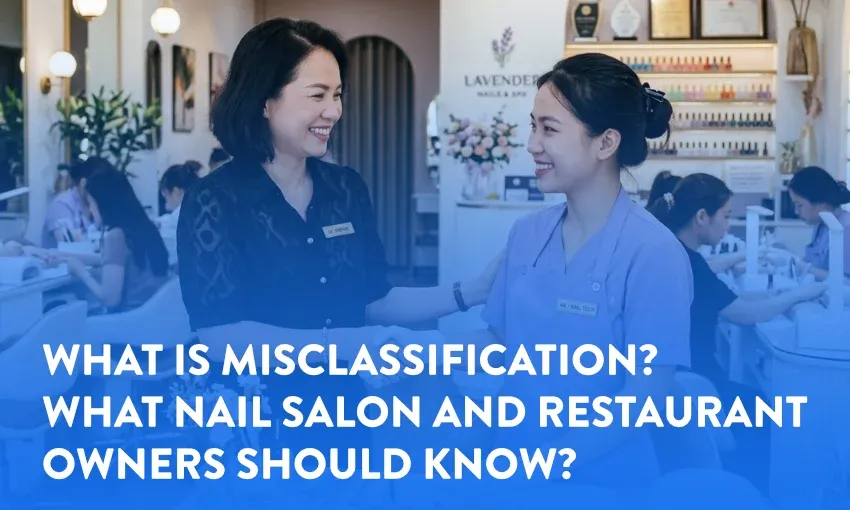
What Is Misclassification? What Nail Salon and Restaurant Owners Should Know
"Misclassification" sounds like a distant legal term, but it accurately describes what's happening in many Vietnamese-owned nail salons and restaurants across the U.S.: paying technicians as independent contractors (1099) when the actual working relationship meets every criterion of an employee (W-2). This article explains the concept, why it's so common in this industry, and — most importantly — the real consequences of getting caught.
1. What misclassification means under U.S. law
Misclassification occurs when a business labels a worker as an "independent contractor" (paid via 1099-NEC) while the actual working relationship meets the IRS and Department of Labor's definition of an "employee" (who must be paid via W-2).
Key point: this is not about intent. A business owner can misclassify workers with no intention to defraud — simply because it's standard industry practice and no one clearly explained the legal boundary. But the law doesn't weigh good intentions; it weighs actual control over the work.
2. Why this is especially common in Vietnamese-owned salons
Three industry traits make misclassification a systemic risk, not an isolated one:
- Family and word-of-mouth business models: Salons are often passed down between generations or friends, and the 1099 habit gets copied from one owner to the next without legal review.
- Commission-based pay structure: Technicians typically earn a percentage of service revenue, which can mislead owners into assuming this automatically makes it a "partnership" rather than an employer-employee relationship.
- Cost competition pressure: Paying 1099 immediately saves the employer-side payroll taxes, creating an incentive to keep the old practice despite known risk.
3. The specific legal and financial consequences
This is the part most often underestimated. When a salon is found to have misclassified workers, consequences go well beyond "paying back taxes":
| Consequence | Details |
|---|---|
| Back payroll taxes | The IRS collects unpaid Social Security, Medicare, and federal unemployment (FUTA) taxes retroactively — often up to 3 years or more |
| Penalties and interest | Filing-error penalties plus interest calculated on the full back-tax amount, compounding over time |
| Overtime pay | If a worker exceeded 40 hours/week without proper 1.5x overtime pay under the FLSA, the business owes the difference |
| Back unemployment insurance | State unemployment agencies may collect unpaid premiums for all misclassified workers |
| Criminal exposure | If authorities determine willful misclassification, owners may face criminal, not just civil, liability |
4. Who can trigger an investigation — where the risk actually comes from
Many owners assume risk only comes from a random IRS audit. In reality, the most common paths to detection are:
- Unemployment claims — when a former worker files, the unemployment agency reviews the business's worker classification history.
- Worker complaints — current or former employees filing complaints with the Department of Labor over improper pay.
- Cross-agency audits — the IRS, federal DOL, and state labor agencies share information when misclassification signals appear.
- Business partner disclosures — landlords or tax accountants noticing irregularities in tax filings.
5. How to fix and prevent it
Good news: misclassification is fixable if addressed proactively before detection. Basic steps include:
- Reviewing every technician role against the IRS's work-control criteria
- Converting eligible positions to W-2 properly (W-4, I-9, payroll setup)
- Considering the IRS Voluntary Classification Settlement Program for proactive correction before an audit
- Working with an experienced payroll partner to convert without disrupting operations
The next article in this series covers each conversion step in detail, including required forms and an implementation checklist.
Frequently Asked Questions
Q: Is misclassification a criminal offense?
A: Not by default. Most cases are handled civilly (back taxes, fines). Criminal liability only applies where willful, systematic tax evasion is proven.
Q: My salon is small — only 3-5 techs. Am I really at risk?
A: Yes. Business size doesn't determine audit likelihood — most cases start from an individual worker's complaint, regardless of company size.
Q: We've paid 1099 for years — will switching to W-2 now trigger back-tax liability for prior years?
A: It's possible, but risk is significantly lower when a business proactively corrects classification before being audited, compared to being caught first.
Don't let one former employee's unemployment claim become years of back taxes. Contact TAXtical for a free worker classification assessment →
————————————
TAXtical LLC - Tax, Legal & Business Advisory Services
📞 (225) 506-7919
📧 [email protected]
📍 12562 S Harrells Ferry Rd, Baton Rouge, LA 70816
Sources: IRS — Worker Classification / Section 530 Relief, U.S. Department of Labor — Misclassification Initiative